
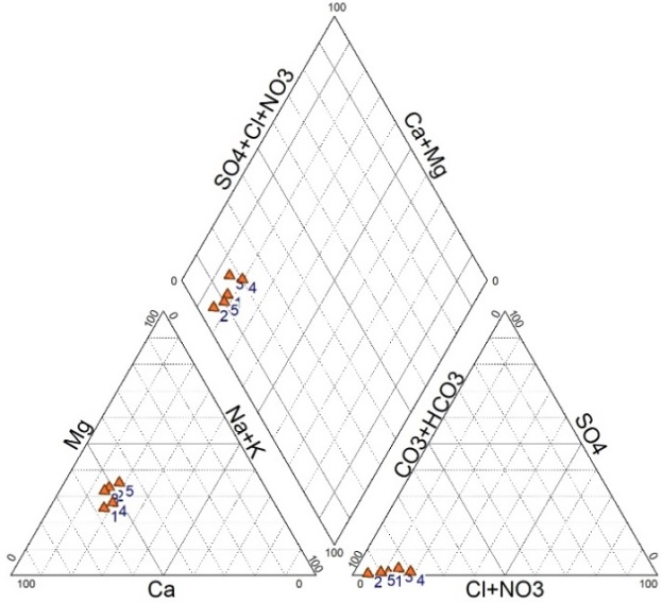
Access to drinking water is a major concern in the locality of least developing countries. Population growth and the demands of modern life require an increase in water production in both quantity and quality. This study aims to determine the physicochemical and microbiological quality of water from boreholes intended for human consumption in the 2nd district of N'Djamena, Chad. The methods used to solve the problem are based on physicochemical and microbiological analyses, the Piper diagram interpretation, and multivariate statistical analysis to determine the quality and classification of the water. The results show that the water has low mineralization with a Total Dissolved Solid (TDS) concentration of 141.2 ± 26.61 mg/L and an average electrical conductivity of 282.4 ± 53.58 µS/cm. And then, determination of the facies of the waters studied shows that they are of the calcium-magnesium bicarbonate type. The highest concentrations are those of Ca2+ (38.3 ± 7.79 mg/L) and HCO3- (189.76 ± 17.36 mg/L), and the lowest are K+ (3.06 ± 0.63 mg/L) and NO3- (5.76 ±9.43 mg/L). The water contains fecal coliforms such as Escherichia coli, total coliforms, and Total Aerobic Mesophilic Flora. Due to the presence of these pathogenic germs, this water requires prior treatment before being used for human consumption.
| Published in | Journal of Water Resources and Ocean Science (Volume 14, Issue 2) |
| DOI | 10.11648/j.wros.20251402.11 |
| Page(s) | 35-44 |
| Creative Commons |
This is an Open Access article, distributed under the terms of the Creative Commons Attribution 4.0 International License (http://creativecommons.org/licenses/by/4.0/), which permits unrestricted use, distribution and reproduction in any medium or format, provided the original work is properly cited. |
| Copyright |
Copyright © The Author(s), 2025. Published by Science Publishing Group |
Physicochemical, Bacteriological, Drinking Water, N'Djamena
WHO (2004) | F1 | F2 | F3 | F4 | F5 | Min | Max | Average | S-D | CV | |
|---|---|---|---|---|---|---|---|---|---|---|---|
T°C | 29,46 | 29,1 | 29,9 | 31 | 29,8 | 29,1 | 31 | 29,85 | 0,71 | 2,39 | |
pH | 6,5–8,5 | 7,1 | 6,40 | 6,97 | 7,20 | 7,05 | 6,4 | 7,2 | 6,94 | 0,32 | 4,54 |
EC (µS/cm) | ≤500 | 280 | 219,0 | 286,0 | 366,0 | 261,0 | 219 | 366 | 282,4 | 53,58 | 18,97 |
TDS (mg/L) | 500 | 139 | 110,0 | 143,0 | 183,0 | 131,0 | 110 | 183 | 141,2 | 26,61 | 18,85 |
Ca2+ (mg/L) | ≤100 | 45 | 28,5 | 40,0 | 46,0 | 32,0 | 28,5 | 46 | 38,3 | 7,79 | 20,34 |
Mg2+ (mg/L) | ≤150 | 12,3 | 11,3 | 14,6 | 14,6 | 14,6 | 11,3 | 14,6 | 13,48 | 1,57 | 11,68 |
K+ (mg/L) | ≤200 | 3,2 | 2,4 | 2,4 | 3,6 | 3,7 | 2,4 | 3,7 | 3,06 | 0,63 | 20,62 |
Na+ (mg/L) | ≤200 | 14,2 | 8,6 | 11,3 | 17,4 | 12,0 | 8,6 | 17,4 | 12,7 | 3,30 | 26,00 |
NH4+ (mg/L) | ≤0,5 | 0,206 | 1,01 | 0,77 | 0,77 | 0,54 | 0,2 | 1,01 | 0,66 | 0,30 | 45,96 |
Cl- (mg/L) | <200 | 10,8 | 5,0 | 19,0 | 16,0 | 10,0 | 5 | 19 | 12,16 | 5,46 | 44,91 |
SO42- (mg/L) | <250 | 2 | 1,0 | 5,0 | 3,0 | 2,0 | 1 | 5 | 2,6 | 1,52 | 58,33 |
NO3- (mg/L) | <50 | 7,1 | 0,0 | 0,0 | 21,7 | 0,0 | 0 | 21,7 | 5,76 | 9,43 | 163,65 |
HCO3- (mg/L) | 198,7 | 168,4 | 195,2 | 210,8 | 175,7 | 168,4 | 210,8 | 189,76 | 17,36 | 9,15 | |
Fe2+ (mg/L) | 0,01 | 0,0 | 0,0 | 0,5 | 0,0 | 0 | 0,5 | 0,102 | 0,22 | 218,17 | |
E. Coli (ufc/100 ml) | 0 | 0 | 0 | 18 | 0 | 0 | 18 | 3,6 | 8,05 | 223,61 | |
TCB (ufc/100 ml) | 33 | 0 | 0 | 9 | 0 | 0 | 33 | 8,4 | 14,29 | 170,16 | |
FE (ufc/100 ml) | 1 | 0 | 0 | 0 | 0 | 0 | 1 | 0,2 | 0,45 | 223,61 | |
TAMF (ufc/100 ml) | >100 | >100 | >100 | >100 | >100 |
Variables | pH | EC | TDS | Ca2+ | Mg2+ | K+ | Na+ | NH4+ | Cl- | SO42- | NO3- | HCO3- | Fe2+ |
|---|---|---|---|---|---|---|---|---|---|---|---|---|---|
pH | 1 | ||||||||||||
EC | 0,789 | 1 | |||||||||||
TDS | 0,783 | 1,000 | 1 | ||||||||||
Ca2+ | 0,786 | 0,832 | 0,820 | 1 | |||||||||
Mg2+ | 0,724 | 0,637 | 0,645 | 0,345 | 1 | ||||||||
K+ | 0,716 | 0,522 | 0,523 | 0,326 | 0,467 | 1 | |||||||
Na+ | 0,854 | 0,932 | 0,927 | 0,860 | 0,485 | 0,712 | 1 | ||||||
NH4+ | -0,636 | -0,138 | -0,121 | -0,496 | -0,060 | -0,503 | -0,417 | 1 | |||||
Cl- | 0,670 | 0,725 | 0,725 | 0,681 | 0,778 | 0,052 | 0,517 | -0,069 | 1 | ||||
SO42- | 0,459 | 0,485 | 0,486 | 0,478 | 0,698 | -0,204 | 0,230 | 0,050 | 0,951 | 1 | |||
NO3- | 0,560 | 0,889 | 0,888 | 0,731 | 0,268 | 0,534 | 0,905 | -0,071 | 0,358 | 0,077 | 1 | ||
HCO3- | 0,779 | 0,917 | 0,909 | 0,978 | 0,457 | 0,322 | 0,881 | -0,330 | 0,762 | 0,557 | 0,794 | 1 | |
Fe2+ | 0,462 | 0,876 | 0,881 | 0,565 | 0,391 | 0,483 | 0,805 | 0,189 | 0,392 | 0,144 | 0,951 | 0,686 | 1 |
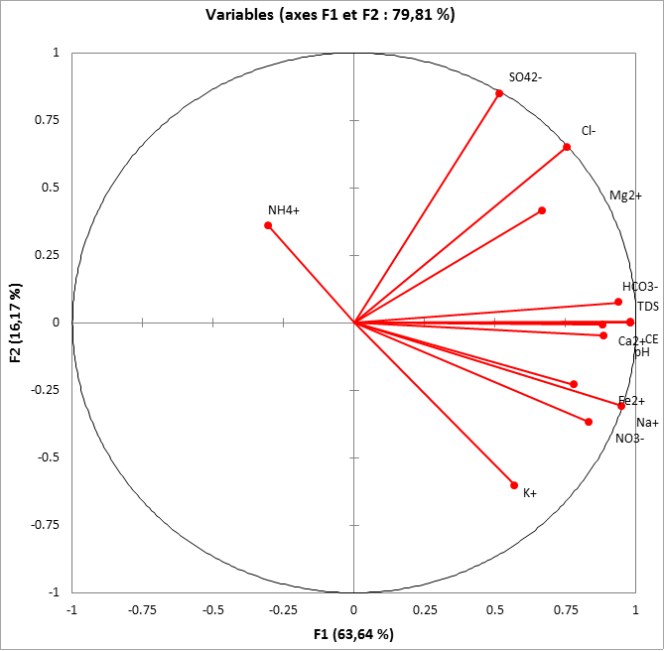
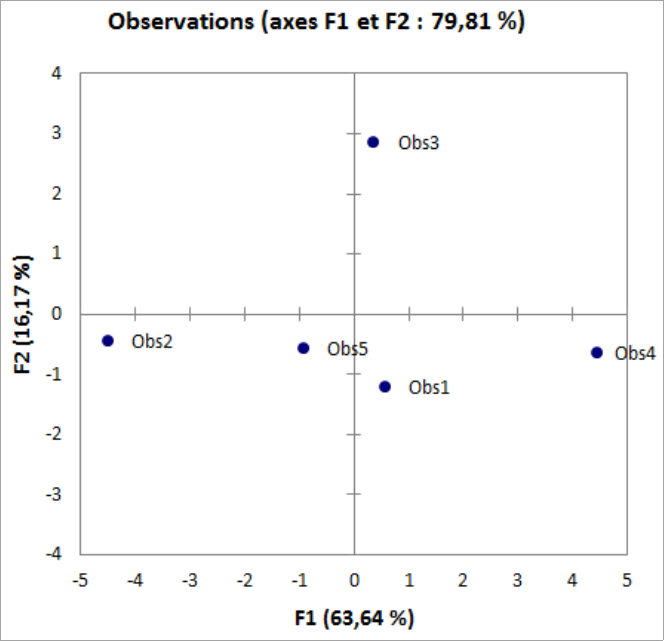
F1 | F2 | F3 | F4 | |
|---|---|---|---|---|
Eigenvalue | 8,273 | 2,102 | 1,619 | 1,006 |
Variability (%) | 63,642 | 16,168 | 12,454 | 7,737 |
% cumulative | 63,642 | 79,810 | 92,263 | 100,000 |
CV | Correlation of Variation |
PCA | Principal Component Analysis |
SD | Standard deviation |
TDS | Total Dissolved Solid |
WHO | World Health Organization |
| [1] | Tampo, L., Gnazou, M., Akpataku, V., Bawa, L. et Djaneyé-Boundjou, G. (2015). Application of statistical methods to the hydrochemical study of water in a tropical hydrosystem: the case of the Zio river catchment (Togo). European Scientific Journal, 11(14), (pp. 204-225). |
| [2] | Butuena, B. A. N., Samba, L. C., Katende, K. P., Lokango, O. O., Mbanji, K. J., & Tshefu, L. L. (2024). Modes of access to water and socio-economic conditions of households, case of the commune of Lemba. Revue Internationale De La Recherche Scientifique (Revue-IRS), 2(1), 101–116. |
| [3] | Diawara, H., Ahimir S., Berthé, T., & Guindo, A. (2021 Study of the Contribution of Boreholes in Improving Access to Drinking Water in the N’Tabacoro District, City Extension in Bamako. European Scientific Journal, ESJ, 17(40), 106. |
| [4] | Aissi, J-R. (2023). Effect of population growth on sanitation in the town of Lokossa. Revue Della Afrique; pp 130-153. |
| [5] | Azonnakpo, O. V., Azonnakpo, J. P., Agbossou, E. K., & Aminou, T. (2020). Inventory of activities in the Oueme Delta and sources of water pollution. International Journal of Progressive Sciences and Technologies, 20(2), 376-390. |
| [6] | Foto, M. S., Zebaze, T. S. H., Nyamsi T. N. L., Ajeagah, G. A. et Njiné, T. (2011). Spatial evolution of the diversity of benthic macroinvertebrate populations in an anthropised river in a tropical environment (Cameroon). European Journal of Scientific Research, 55(2), (pp. 291-300). |
| [7] | UN (United Nations). (2019). Report on the sustainable development goals. |
| [8] | UNICEF/WHO. (2019). Progress in household water, sanitation and hygiene 2000-2017: close-up on inequalities. UNICEF/WHO, Switzerland, 140 p. |
| [9] |
World Health Organization (2004) Guidelines for Drinking Water Quality, Vol. 1 Recommendations. 3rd Edition, WHO, Geneva; 110 p.
https://www.who.int/water_sanitationhealth/publications/facts2004/en/index.html |
| [10] | Karambiri, I., Dabire, A. M., Zoungrana, B., Meda, N. S. D., & Ouedraogo, B. (2023). Assessment of the bacteriological and physico-chemical quality of well water in the town of Dédougou, Burkina Faso. Afrique SCIENCE, 23(2), 1-13. |
| [11] | Adesakin, A. T., Oyewale, T. A., Bayero, U., Mohammed, A. N., Aduwo, I. A., Zubeidat, P. A., Dalhata, N. A., Balkisu, I. B. (2020) Assessment of bacteriological quality and physico-chemical parameters of domestic water sources in Samaru community, Zaria, Northwest Nigeria, Elsevier, Heliyon (6) e04773, 13 p. |
| [12] | Traore, A., Soro, T. D., Dibi, B., & Yao, L. J. A. (2022). Hydrogeochemical characterisation of groundwater in the department of Man (West of Ivory Coast). International Journal of Biological and Chemical Sciences, 16(1), 498-514. |
| [13] | Kouz, T., Mansour, S., Mesmoudi, H., Dakak, H., & Cherkaoui Dekkaki, H. (2020). Assessment of groundwater vulnerability to pollution as part of integrated management in coastal areas Case of Ghiss-Nekkour Basin (North East of Morocco). La Houille Blanche, 106(2), 63–73. |
| [14] | Feuillette, S. (2001). Towards demand management on an open-access aquifer: exploring resource-use interactions using multi-agent systems Application to the Kairouan aquifer, Central Tunisia (Doctoral dissertation, Ph. D. Thesis. University of Montpellier II, Montpellier, France). |
| [15] | Ounoki, S. et Achour, S. (2014) Assessment of the physicochemical and bacteriological quality of raw and treated wastewater from the town of Ouargla. Possibility of using it for irrigation. Larhyss Journal, ISSN 1112-3680, pp. 247-258. |
| [16] | Ngaram, N., Tchadanaye, N. M., Merle, A., Lanteri, P. (2011). Physicochemical characterisation of the waters of the Chari River at N'Djamena, Annals of the University of N'Djamena, Série C No 05 p. 93-120. |
| [17] | Kadjangaba, E., Huneau, F., Travi, Y. and Djoret D. (2017). Recharge and Groundwater quality of an Alluvial Aquifer: Case of the City of N’djamena (Chad). Journal of Environmental Science and Engineering B6, p: 493 – 505. |
| [18] | Kadjangaba, E., Djoret, D., Doumnang, M. J. C., Ndoutamia, G. A. and Mahmout, Y. (2018) Impact of Hydrochemical Processes on the Quality of Groundwater in the City of N'Djamena-Chad. European Scientific Journal, 18, 162-177. |
| [19] | Direction des Ressources en Eau et de la Météorologie (DREM), (2012). Climate survey yearbook. Climatology Division, Database. Ann. 289p. |
| [20] | BRGM, (1988). Study of the vulnerability of the superficial aquifers of N’Djamena (Chad) and recommendations for development. 89 p. |
| [21] | BRGM, (1987). Updating knowledge of groundwater resources in the Republic of Chad. First part. General and bibliographical presentation. 185p. |
| [22] | Rodier, J. (2009) Water analysis. Dunod, 9th edition, 1526 p. |
| [23] | AFNOR (French Association for Standardization), (2001). Water quality, major elements - other elements and mineral compounds. Aubenas Ardèche, AFNOR, 635 p. |
| [24] | Simler, R. (2007). Diagramme 4.0 software. University of Avignon, France. |
| [25] | Yéo, K. M., Kouadio, A. N. B., & Goné, D. L. (2023). Assessment of the quality of borehole and well water intended for human consumption: multivariate analysis approaches. International Journal of Innovation and Applied Studies, 40(4), 1299-1311. |
| [26] | Soro, G., Soro, T. D., Fossou, N. M. R., Adjiri, O. A., Soro, N. (2019). Application of multivariate statistical methods to the hydrochemical study of groundwater in the lakes region (Central Ivory Coast). International Journal of Biological and Chemical Sciences, 13(3): 1870-1889. |
| [27] | Mahamat, S. A. M., Maoudombaye, T., Abdelsalam, T., Ndoumtamia, G., & Loukhman, B. (2015). Assessment of the physico-chemical quality of the public water supply of the Société Tchadienne des Eaux in N'djamena, Chad. Journal of Applied Biosciences, 95, 8973-8980. |
| [28] | Kuitcha, D., Fouepe, A. et Ndjama J. (2013). The contribution of hydrochemistry and environmental isotopes to knowledge of groundwater resources in Yaoundé, Cameroon. Journal of Applied Biosciences. 67. 5194-5208. |
| [29] | Gaagai, A. (2017). Study of the evolution of the water quality of the Babar dam (South-East of Algeria) and the impact of the dam failure on the environment Doctoral dissertation, univ Batna 2, 2017. |
| [30] | Gouaidia, L., Laouar M. S., Defaflia, N., & Zenati, N., (2017). Origin of the mineralisation of groundwater in an aquifer in a semi-arid zone, the case of the Merdja aquifer, North - East Algeria. International Journal of Environment & Water. Vol 6(2): 104-118. |
| [31] | Matini, L, Moutou, JM, Kongo-Mantono, MS. 2009. Hydrochemical assessment of urban groundwater in south-west Brazzaville, Congo. Afrique Science, 05(1): 82-98. |
| [32] | Abdramane. H (2012). Study of the hydrogeochemical functioning of the Chari-Baguirmi aquifer system (Chad). Doctoral thesis, University of Poitiers, 324p. |
| [33] | Essouli, O. F. (2005). ‘Impact of the public landfill of Lake Mbeubeuss on the water resources of the Thiaroye Quaternary sand aquifer (Dakar, Senegal)’, Doctoral thesis, 3rd cycle, Université C. A. D. University, Senegal. |
| [34] | Ewodo, M. G., Bon, A., Bineli, A., Nangyana, N., Gaiba, K., Ombolo, A. (2019). Hydrogeochemistry of subsurface and deep aquifers in the city of N'djamena. Journal of the Cameroon Academy of Sciences. 14. 227. 10.4314. |
| [35] | Yaka, D. A. M., Tiemeni, A. A., Zing, B. Z., Nenkam, T. L. L. J., Aboubakar, A., Nzeket, A. B., et Mewouo, Y. C. M. (2020). Physicochemical and bacteriological quality of groundwater and health risks in some districts of Yaoundé VII, Cameroon. International Journal of Biological and Chemical Sciences, 14(5), 1902-1920. |
| [36] | Cloutier, V., Lefebvre, R., Therrien, R. & Savard, M. M., (2008). Multivariate statistical analysis of geochemical data as indicative of the hydro-geochemical evolution of groundwater in a sedimentary rock aquifer system. Journal of Hydrology, 353: 294–313. |
| [37] | Sadek, A. (2011). Hydrochemistry and geochemical facies of groundwater, Bekaa Plain. Hydrological Sciences Journal, 56(2): 334-348. |
| [38] | Ahoussi, K. E., Soro N., Koffi, Y. B., Soro, G., Biémi, J. 2010. Origin of water mineralisation in discontinuous aquifers under forest cover in the southern zone of Ivory Coast: the case of the Abidjan-Agboville region. International Journal of Biological and Chemical Sciences, 4(3): 782- 797. |
| [39] | Derwich, E., Benaabidate, L., Zian, A., Sadki, O., Belghity, D. (2010). Physicochemical characterisation of the alluvial groundwater of the Haut Sebou downstream of its confluence with Oued Fes. Larhyss Journal, 08: 101-112. |
APA Style
Emmanuel, A. A., Ahmadou, B., Diab, D. A., Oumar, I. A., Janvier, D. K. (2025). Hydrochemical and Bacteriological Characterization of Drinking Water in N'Djamena: A Case Study of the 2nd District. Journal of Water Resources and Ocean Science, 14(2), 35-44. https://doi.org/10.11648/j.wros.20251402.11
ACS Style
Emmanuel, A. A.; Ahmadou, B.; Diab, D. A.; Oumar, I. A.; Janvier, D. K. Hydrochemical and Bacteriological Characterization of Drinking Water in N'Djamena: A Case Study of the 2nd District. J. Water Resour. Ocean Sci. 2025, 14(2), 35-44. doi: 10.11648/j.wros.20251402.11
AMA Style
Emmanuel AA, Ahmadou B, Diab DA, Oumar IA, Janvier DK. Hydrochemical and Bacteriological Characterization of Drinking Water in N'Djamena: A Case Study of the 2nd District. J Water Resour Ocean Sci. 2025;14(2):35-44. doi: 10.11648/j.wros.20251402.11
@article{10.11648/j.wros.20251402.11,
  author = {Aguiza Abai Emmanuel and Baba Ahmadou and Diab Ahmad Diab and Ilyass Ali Oumar and Domra Kana Janvier},
  title = {Hydrochemical and Bacteriological Characterization of Drinking Water in N'Djamena: A Case Study of the 2nd District
},
  journal = {Journal of Water Resources and Ocean Science},
  volume = {14},
  number = {2},
  pages = {35-44},
  doi = {10.11648/j.wros.20251402.11},
  url = {https://doi.org/10.11648/j.wros.20251402.11},
  eprint = {https://article.sciencepublishinggroup.com/pdf/10.11648.j.wros.20251402.11},
  abstract = {Access to drinking water is a major concern in the locality of least developing countries. Population growth and the demands of modern life require an increase in water production in both quantity and quality. This study aims to determine the physicochemical and microbiological quality of water from boreholes intended for human consumption in the 2nd district of N'Djamena, Chad. The methods used to solve the problem are based on physicochemical and microbiological analyses, the Piper diagram interpretation, and multivariate statistical analysis to determine the quality and classification of the water. The results show that the water has low mineralization with a Total Dissolved Solid (TDS) concentration of 141.2 ± 26.61 mg/L and an average electrical conductivity of 282.4 ± 53.58 µS/cm. And then, determination of the facies of the waters studied shows that they are of the calcium-magnesium bicarbonate type. The highest concentrations are those of Ca2+ (38.3 ± 7.79 mg/L) and HCO3- (189.76 ± 17.36 mg/L), and the lowest are K+ (3.06 ± 0.63 mg/L) and NO3- (5.76 ±9.43 mg/L). The water contains fecal coliforms such as Escherichia coli, total coliforms, and Total Aerobic Mesophilic Flora. Due to the presence of these pathogenic germs, this water requires prior treatment before being used for human consumption.
},
 year = {2025}
}
TY  - JOUR
T1  - Hydrochemical and Bacteriological Characterization of Drinking Water in N'Djamena: A Case Study of the 2nd District

AU  - Aguiza Abai Emmanuel
AU  - Baba Ahmadou
AU  - Diab Ahmad Diab
AU  - Ilyass Ali Oumar
AU  - Domra Kana Janvier
Y1  - 2025/03/21
PY  - 2025
N1  - https://doi.org/10.11648/j.wros.20251402.11
DO  - 10.11648/j.wros.20251402.11
T2  - Journal of Water Resources and Ocean Science
JF  - Journal of Water Resources and Ocean Science
JO  - Journal of Water Resources and Ocean Science
SP  - 35
EP  - 44
PB  - Science Publishing Group
SN  - 2328-7993
UR  - https://doi.org/10.11648/j.wros.20251402.11
AB  - Access to drinking water is a major concern in the locality of least developing countries. Population growth and the demands of modern life require an increase in water production in both quantity and quality. This study aims to determine the physicochemical and microbiological quality of water from boreholes intended for human consumption in the 2nd district of N'Djamena, Chad. The methods used to solve the problem are based on physicochemical and microbiological analyses, the Piper diagram interpretation, and multivariate statistical analysis to determine the quality and classification of the water. The results show that the water has low mineralization with a Total Dissolved Solid (TDS) concentration of 141.2 ± 26.61 mg/L and an average electrical conductivity of 282.4 ± 53.58 µS/cm. And then, determination of the facies of the waters studied shows that they are of the calcium-magnesium bicarbonate type. The highest concentrations are those of Ca2+ (38.3 ± 7.79 mg/L) and HCO3- (189.76 ± 17.36 mg/L), and the lowest are K+ (3.06 ± 0.63 mg/L) and NO3- (5.76 ±9.43 mg/L). The water contains fecal coliforms such as Escherichia coli, total coliforms, and Total Aerobic Mesophilic Flora. Due to the presence of these pathogenic germs, this water requires prior treatment before being used for human consumption.

VL  - 14
IS  - 2
ER  -
Department of Industrial Security, Quality and Environment, National Advanced School of Mines and Petroleum Industries, University of Maroua, Kaele, Cameroon
Institute of Geological and Mining Research (IRGM), Nlongkak, Yaounde, Cameroon
Department of Physics, Teachers Training Higher School of N’Djamena, N’Djamena, Chad
Department of Refining and Petrochemistry, National Advanced School of Mines and Petroleum Industries, University of Maroua, Kaele, Cameroon
Department of Mining, Petroleum and Water Resources Exploration, National Advanced School of Mines and Petroleum Industries, University of Maroua, Kaele, Cameroon




 Share This Article
 Twitter
 Linked In
 Facebook
 Copy
Copy Download